What Is “Nuclear Piracy”?
October 5, 2026
I began my PhD at the Hacettepe University in Turkiye in September 2021, mere months before Russia’s invasion of Ukraine, which involved the occupation of the Zaporizhzhia Nuclear Power Plant, the Europe’s largest nuclear power plant. I had already developed an interest in a question that I felt nuclear security had traditionally ignored: what happens when the threat to a nuclear facility comes not from terrorists or criminals, but from another state?
Then, the Zaporizhzhia occupation happened, which showed me that this guiding question was on the right path. That question eventually led me to studying and developing “nuclear piracy.” I found the nuclear threat reduction field was often trying to describe a new risk–”weaponization of nuclear facilities”–using old terms. I felt that if the risk was genuinely new, it needed a new term. “Nuclear piracy” is more of a metaphor than a legal definition.
I define it as the illicit acquisition, manipulation, and exploitation of nuclear materials and facilities for strategic purposes. I highly believe that it is a way of making visible something that I felt we were struggling to name.
A few years later, I applied to the Ploughshares–Horizon 2045 Nuclear Futures Fellowship. The first year, in 2024, I proceeded to the interview stage, but was ultimately not selected. But I did not give up. I prepared a better application, interviewed again, and joined the 2025 cohort of fellows.
My persistence stemmed from knowing how the fellowship would go beyond another line on my CV. I was sure that the community, programming, and capstone would give me a way of thinking about how today’s risks could shape tomorrow’s nuclear landscape. The fellowship gave me just that—and much more. Erika Gregory from Horizon 2045, and Habib Bako and Alex Hall from Ploughshares, created the space for us to focus on research and build relationships with the organizers and other fellows that enriched me both as a researcher and as a person.
This journey so far has culminated in my fellowship capstone project. One of the parts I enjoyed most was interviewing experts for this project. It was an amazing experience to arrange interviews, transcribe them, and find ways to integrate their perspectives into the project. Fourteen people from different geographical, professional, generational, and gender backgrounds helped me so that I could come up with a body of work is global in perspective.
I should also admit something: I was afraid of, but excited about, introducing a new term. I have found the nuclear field can be resistant to new language. Before “nuclear piracy” was first published in 2023, someone I discussed the idea with told me it was a useless term and tried hard to discourage me from “wasting” my time on it. And yet, I felt there was value to exploring it further. Today, hearing “nuclear piracy” used in the International Atomic Energy Agency (IAEA) corridors is deeply meaningful to me and makes me glad I did not give up on my idea and hope of moving the nuclear threat reduction community forward.
By 2045, there will likely be many more nuclear facilities around the world. For me, 2045 became a way to think beyond Zaporizhzhia and ask how changes in technology, warfare, infrastructure, and governance could reshape nuclear security over the next two decades. The questions ahead are about choices. Will we build new ways to protect nuclear facilities, or will we allow normalization of attacks against them? I wrote my capstone paper because I could not accept sitting still and hoping nothing worse happens to places like Zaporizhzhia. We cannot accept the normalization of attacks on nuclear facilities.
This is not the end of my original, guiding question. It is the beginning of the next phase of this work. I hope you’ll stay tuned for this phase, where I will expand upon the idea of nuclear piracy beyond occupation and examine the ways nuclear facilities could be targeted in the future.
The impact of the Fellowship has continued beyond the capstone itself. In August 2026, I received the Institute of Nuclear Materials Management Early Career Award in Austin, Texas, recognizing my research and contributions to nuclear security. To me, this was also a meaningful validation of the research direction that the Fellowship and its organizers had encouraged me to pursue. The support, conversations, and community I found through the Fellowship gave me the confidence to keep developing ideas that may not always fit neatly into existing categories. I am carrying that encouragement into the next phase of my work—and there is much more to come.
Read my full white paper, Nuclear Piracy: Weaponization of Nuclear Facilities, here.
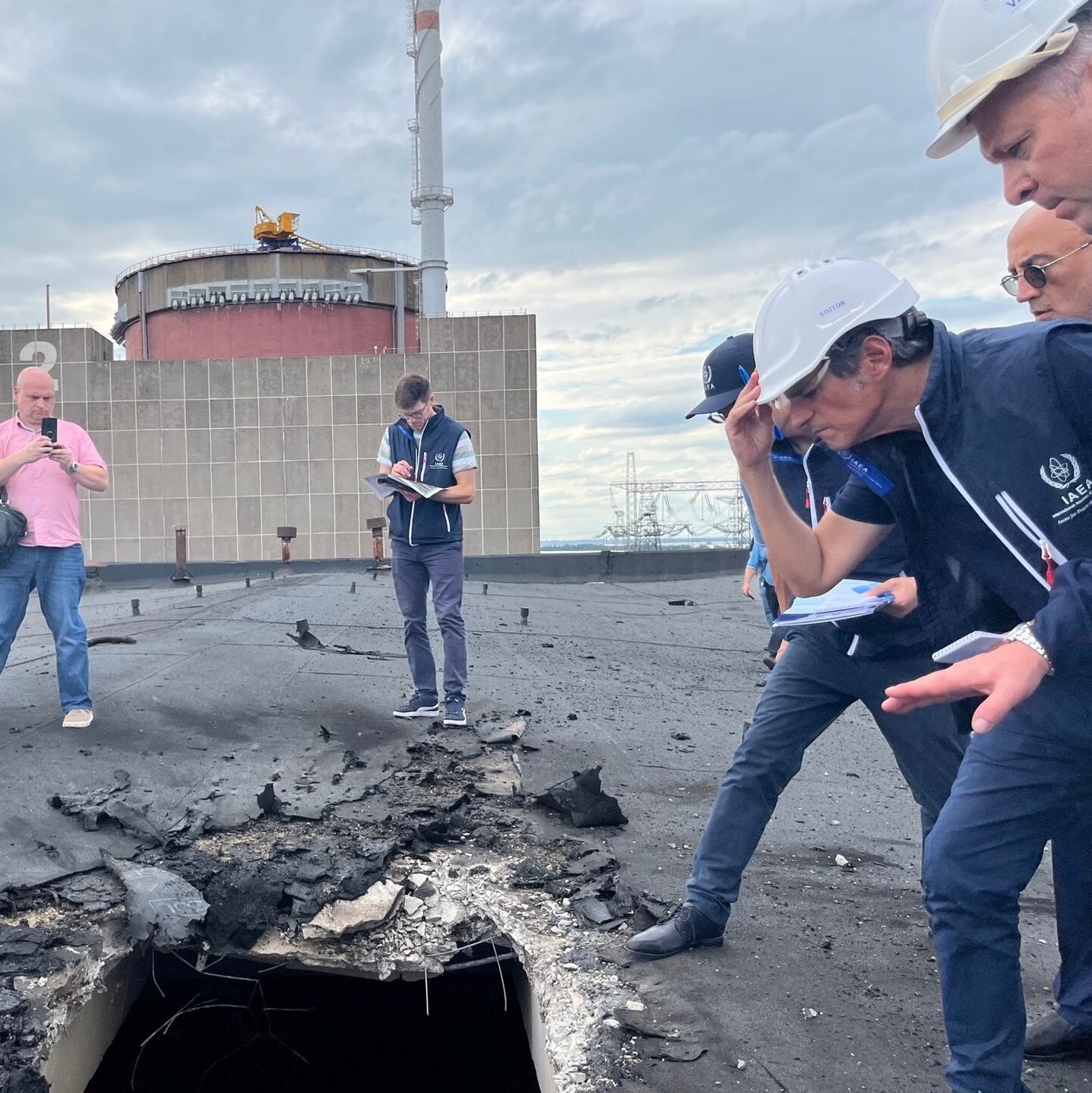
Image: The IAEA Support and Assistance Mission to Zaporizhzhya. 1 September 2022. Photo Credit: Fredrik Dahl / IAEA